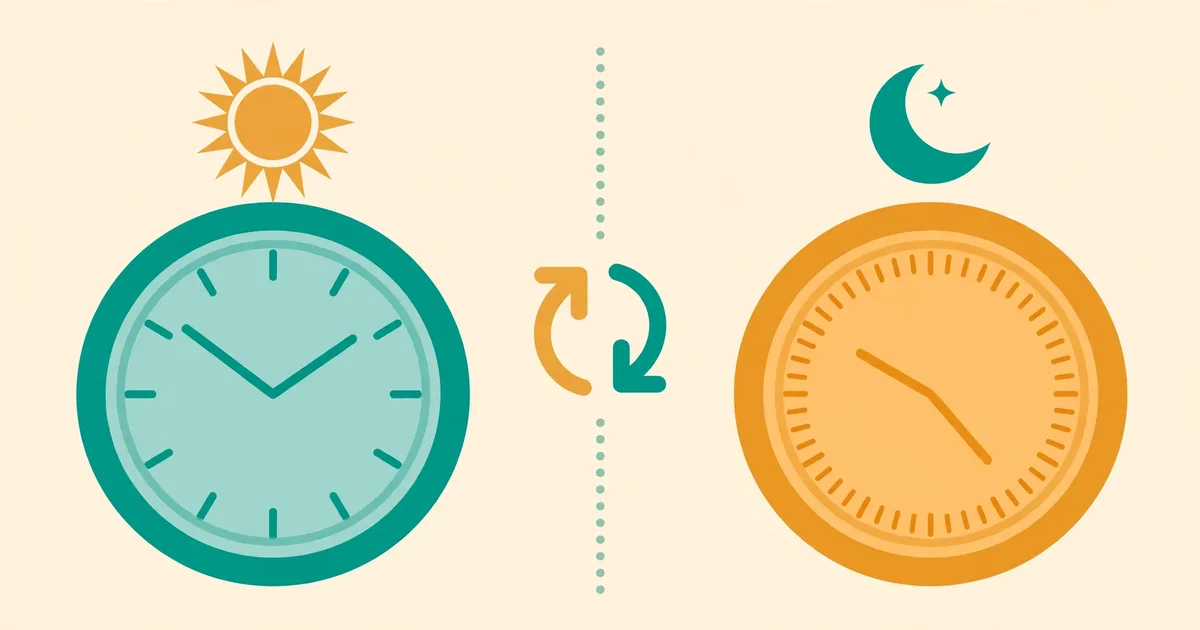
Most of the world writes time in one of two systems. The 12-hour clock splits the day into AM and PM. The 24-hour clock counts all the way from 00:00 to 23:59.
How the 12-hour clock works
- AM (ante meridiem) covers midnight to 11:59 in the morning.
- PM (post meridiem) covers noon to 11:59 at night.
The tricky part: 12 AM is midnight (the start of the day) and 12 PM is noon. This is the single most common source of scheduling mistakes.

The 12 AM trap, explained properly
The confusion comes from where the number 12 sits. In the 12-hour clock, each half of the day runs 12, 1, 2, 3, all the way to 11. The 12 belongs to the start of each half, not the end.
So 12:00 AM to 12:59 AM is the first hour after midnight, the very beginning of the day. And 12:00 PM to 12:59 PM is the first hour after noon, the middle of the day. The classic mistake is reading “12 PM” as “12 hours after midnight” and landing on midnight. By convention it means noon.
A handy check: AM comes before PM in the alphabet, and midnight comes before noon in the day. So 12 AM is the earlier one (midnight) and 12 PM is the later one (noon). When it really matters, skip the numbers entirely and write “midnight” or “noon.”
Converting 12-hour to 24-hour
- For AM times: keep the hour as is, except 12 AM becomes 00. So 9:30 AM is 09:30, and 12:15 AM is 00:15.
- For PM times: add 12 to the hour, except 12 PM stays 12. So 3:45 PM is 15:45, and 12:00 PM is 12:00.
Converting 24-hour to 12-hour
- Hours 00 to 11 become AM (00 becomes 12 AM).
- Hour 12 stays 12 PM.
- Hours 13 to 23: subtract 12 and add PM.
Quick reference table
| 12-hour | 24-hour | 12-hour | 24-hour |
|---|---|---|---|
| 12:00 AM (midnight) | 00:00 | 12:00 PM (noon) | 12:00 |
| 1:00 AM | 01:00 | 1:00 PM | 13:00 |
| 2:00 AM | 02:00 | 2:00 PM | 14:00 |
| 3:00 AM | 03:00 | 3:00 PM | 15:00 |
| 4:00 AM | 04:00 | 4:00 PM | 16:00 |
| 5:00 AM | 05:00 | 5:00 PM | 17:00 |
| 6:00 AM | 06:00 | 6:00 PM | 18:00 |
| 7:00 AM | 07:00 | 7:00 PM | 19:00 |
| 8:00 AM | 08:00 | 8:00 PM | 20:00 |
| 9:00 AM | 09:00 | 9:00 PM | 21:00 |
| 10:00 AM | 10:00 | 10:00 PM | 22:00 |
| 11:00 AM | 11:00 | 11:00 PM | 23:00 |

Where each system dominates
The 24-hour clock is standard across most of Europe and Asia, and in several fields worldwide, because it removes all AM/PM ambiguity. The 12-hour clock remains common in everyday speech in the US, UK, and several other countries.
Specific fields made the switch because mistakes there are expensive:
- Aviation: flight plans, weather reports, and air traffic control run on 24-hour UTC worldwide. A misread AM/PM at 35,000 feet is not an option.
- Military: orders use 24-hour time (“report at oh-four-hundred hours”) for the same reason.
- Hospitals: medication schedules and shift handovers use 24-hour time to prevent dosing errors.
- Computing: server logs, booking systems, and code (cron jobs, timestamps) all use 24-hour time.
In everyday life across most of continental Europe and Asia, the 24-hour clock is simply the default: on timetables, shop signs, and phone screens.
Two tricks that make conversion instant
Trick 1: the PM plus-12. For any PM time except 12 PM, add 12 to the hour: 7 PM becomes 19:00, 11:20 PM becomes 23:20. 12 PM stays 12:00. That is the whole rule.
Trick 2: the morning mirror. AM times before 10 need a leading zero to look right in 24-hour form: 9 AM is 09:00, not 9:00. This matters when sorting times or typing them into forms that expect two digits.
Going the other way, subtract 12 from any hour above 12 (18:00 becomes 6 PM), and remember that 00:xx always means the small hours of the morning: 00:30 is 12:30 AM.
Avoiding the 12 AM mistake
When scheduling anything important across time zones, write the time in 24-hour format or spell it out (“midnight” / “noon”). Our Time Zone Converter shows converted times clearly so nothing gets lost.